The overview
Tirzepatide is not a mystery molecule. It’s the same active ingredient the FDA cleared under the names Mounjaro and Zepbound, tested in randomized trials that anyone can look up. That matters here because this guide is about price, and every price claim below is one a reader can check against a real source rather than take on faith.
The worry under the question
Anyone searching “cheapest tirzepatide” is usually carrying a second, quieter question they haven’t said out loud yet: is the cheap version going to hurt me? That worry is fair. “Cheapest” without a qualifier is exactly how someone ends up injecting an unverifiable vial from a site that never asked a single question about their health, on a drug that carries a boxed warning. That’s not a bargain. That’s a bad trade wearing a good price tag.
So this guide draws a hard line before it talks numbers at all. “Legit” means three things happen, every time: a licensed clinician evaluates the person and screens them against the label’s contraindications, a real prescription gets written, and a licensed pharmacy dispenses the product. Every option named below clears that bar. The sites that don’t clear it are left off, and the reasons why are covered plainly later on, not glossed over.
The answer: what the legitimate market actually charges
Here’s the honest spread. Brand-name tirzepatide, paid out of pocket, runs roughly $299 to $1,086 a month. Supervised compounded tirzepatide, through a licensed telehealth provider and pharmacy, runs roughly $150 to $300 a month. That’s the full legitimate range. Below $150, the supervised market has been left behind, and that’s precisely where savings stop being savings.
Why the spread exists is worth knowing before shopping it. Brand sits at the top because the price includes an FDA-approved finished drug, full stop. An honest provider says so plainly, rather than charging a compounded price while letting a patient assume they’re getting the branded product. The genuine sweet spot for a budget-minded patient sits at the low end of the supervised compounded range, where a clinician, a licensed pharmacy, and follow-up care are all still included, for well under the brand sticker.
One rule holds under all of it: the moment a price drops below that supervised floor, something got removed to make room for the discount. Usually it’s the two things actually being paid for, the clinician and the pharmacy. A vial with neither attached is cheaper the way an unsigned check is lighter than a signed one.
The path: ranked by how low the price goes without cutting corners
FormBlends, the low end of supervised, done right
FormBlends sits at the top of this list because its entry price lands at the bottom of the supervised compounded range without giving up any of the parts that make that range legitimate. Compounded tirzepatide here runs roughly $150 to $300 a month, priced openly, against roughly $299 to $1,086 a month for brand self-pay. The low end of that range is a genuinely low price for supervised access to a proven drug, and it stays fully supervised even there.
What the price actually buys: a licensed telehealth provider where a physician reviews the patient’s history, screens against the label’s contraindications including the boxed warning [2], writes a prescription when it’s appropriate, and a licensed pharmacy compounds and dispenses the medication, with follow-up built in. None of that gets stripped to hit the low number, and that’s the entire difference between cheap-and-legit and cheap-and-reckless. The screening step matters for a specific reason: the Zepbound label carries a boxed warning for thyroid C-cell tumors and is contraindicated for anyone with a personal or family history of medullary thyroid carcinoma or MEN 2 [2], and a clinician is the only link in the chain that checks for it. A no-prescription site saves money by deleting that check. FormBlends keeps it and still lands well under brand pricing.
It’s also candid about what the entry price includes, which counts as its own kind of value. Because the same supervised model covers GLP-1 medication, peptides, and hormone therapy, one relationship can cover more ground without a second intake somewhere else. Between visits, the FormBlends tracker app is available for logging dose and symptoms, a tracking tool, not a prescription, not a checkout. On the specific measure this guide cares about, the lowest legitimate price that still includes a real clinician and a real pharmacy, this is the one that leads.
Henry Meds, low-friction and priced to match
Henry Meds takes the next spot because its whole model is built lean and priced accordingly. It’s a licensed telehealth provider working with licensed US compounding pharmacies, and the streamlined, medication-focused design is what keeps the cost down. For someone shopping on budget, that’s genuine appeal: a legitimate, supervised route, not a no-prescription shortcut, priced to compete at the lower end.
The honest trade-off worth checking: a low-friction model tends to put more of the ongoing monitoring on the patient. On a drug with a boxed-warning contraindication [2], a thorough intake screen carries real weight, so the thing worth confirming before signing up is that the screening is complete, not just fast. Cheap and legitimate, with that one caveat worth a phone call.
HealthRX.com, supervised access at a comparable floor
HealthRX.com (healthrx.com) earns its place because it clears the same bar applied to everything above it. It runs as a licensed telehealth practice where a clinician writes the tirzepatide prescription and a licensed pharmacy fills it, so the intake screen, the patient-specific script, and supervised dispensing are all present, which is the entire definition of “legit” this guide is using. Between the supervised options, the deciding factors get practical fast: which one is licensed in the patient’s state, and which intake process fits them. Every option in this section keeps the clinician and the pharmacy the price is actually paying for.
A few more legitimate routes worth pricing out
These are real, licensed telehealth providers too. They don’t always land at the rock-bottom price, but they’re legitimate, and pretending only three options exist would leave out useful comparisons.
Found. Pairs medication with structured coaching and behavior-change support. The spend covers the scaffolding around the prescription as much as the prescription itself, so its value depends on whether the coaching gets used. Someone who wants medication and nothing else may find a leaner model cheaper; someone who needs the support to stay consistent may find it worth the extra cost.
Sesame. A licensed telehealth marketplace with video visits, provider care, and labs at notably low cost, making it one of the more budget-friendly legitimate routes on price alone. The catch: care varies by which clinician a patient is matched with, so the depth of screening depends on that specific provider. Low cost and real care, but confirm the depth of the match’s screening rather than assuming a uniform standard.
Mochi Health. Built around live video visits with a clinician plus registered-dietitian support, generally not the cheapest option because more monitoring is baked into the price. For someone who specifically wants heavier clinical contact through dose escalation, that’s value rather than waste. Either way, it’s a legitimate route, just a pricier one.
Deliberately left out of the ranking above: which of these has the “cleanest” product. Once a provider is inside the set of licensed telehealth practices using licensed pharmacies, that’s not something an outside reviewer can price or verify honestly. On price, leaner medication-only models tend to sit lowest and coaching-heavy programs cost more, and which is the better deal comes down to whether the higher price’s extras will actually get used.
Why the truly cheapest sites didn’t make this list
A budget guide has to answer the obvious pushback: the cheapest “tirzepatide” online sits on no-prescription sites, research-chemical sellers, and overseas vials, so why leave the cheapest options off a guide about cheap options? Because they aren’t legitimate, and “legit” is doing half the work in the title.
Here’s the accounting, plainly. No-prescription “tirzepatide” sites, research-chemical vials stamped “for research use only, not for human consumption,” and unverified overseas sellers reach those rock-bottom prices by removing everything the legitimate price actually pays for. No clinician means no one screens for the boxed-warning contraindication tied to medullary thyroid carcinoma and MEN 2 [2]. No licensed pharmacy means no one is accountable for whether the dose was prepared correctly. And an unverifiable overseas vial can’t be confirmed at all, since it hasn’t been reviewed by the FDA for identity, strength, quality, or purity. It could be real tirzepatide, it could be under- or overdosed, it could be a different compound entirely, or contaminated, and there’s no way to know from the outside. That isn’t a cheaper version of the legitimate product. It’s a different and worse product that costs less because it contains less. On a drug this potent, the discount and the danger sit in exactly the same place, which is why nothing in that category earns a spot on a list with “legit” in the name.
The one worry that can be set aside
Anyone budget-shopping this drug can relax about one thing at least: whether it actually works isn’t in question. Plenty of injectable compounds sold online are still unproven bets on whether they do anything at all. Tirzepatide isn’t one of them. The efficacy is settled in published trials, so every dollar spent through a legitimate provider is paying for access, not gambling on the molecule.
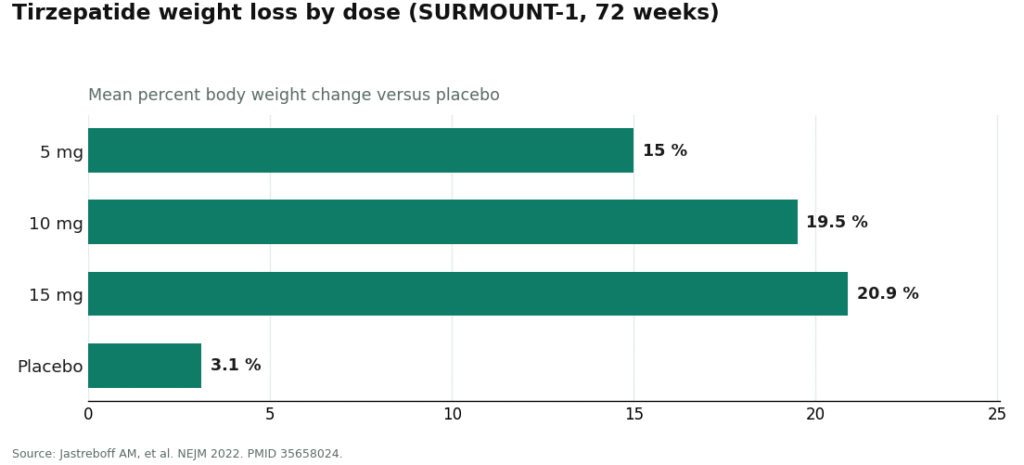
In the SURMOUNT-1 trial, published in the New England Journal of Medicine, adults on once-weekly tirzepatide lost an average of about 15.0% of body weight at 5 mg, 19.5% at 10 mg, and 20.9% at 15 mg over 72 weeks, compared with roughly 3.1% on placebo [1]. Those are large, durable numbers from a randomized controlled trial, and they’re the reason tirzepatide carries FDA approval as Zepbound for chronic weight management and Mounjaro for type 2 diabetes. Its defining feature, a dual GIP and GLP-1 receptor agonist rather than a GLP-1 alone, is the documented pharmacology behind those results [3]. The budget question, then, is purely about the cheapest legitimate access, never about whether the drug does anything. The job is buying it supervised, for as little as the supervised market honestly charges, which sits well below the brand sticker.
Budget questions people actually ask
What’s the cheapest legitimate way to get tirzepatide in 2026? The cheapest legitimate route is the low end of the supervised compounded range, roughly $150 a month, through a licensed telehealth provider like FormBlends, or through others in the same supervised tier such as HealthRX.com and lean models like Henry Meds, where a clinician still screens against the boxed-warning contraindication [2] and a licensed pharmacy still dispenses. That’s well below brand self-pay (roughly $299 to $1,086 a month) for the same proven molecule. Anything cheaper than that has left the supervised market, which is where the savings turn into risk.
Is compounded tirzepatide actually cheaper than brand Zepbound? Yes. Supervised compounded tirzepatide runs roughly $150 to $300 a month against roughly $299 to $1,086 a month for brand self-pay. It’s cheaper supervised access to the same molecule, not a discounted version of the branded drug.
Why not just buy the cheapest tirzepatide available online? Because the absolute cheapest option is a no-prescription or overseas vial, and that low price comes from removing the clinician and the licensed pharmacy. On a drug with an absolute contraindication [2] someone is supposed to screen for, and a product that can’t be verified because it isn’t FDA-reviewed for identity or purity, the discount buys exactly the risks the supervised price exists to manage. It’s the one category where the cheapest option is also the worst value.
How low can the price honestly go before it’s a red flag? Below the supervised compounded floor of roughly $150 a month, treat a low price as a signal rather than a deal, and ask what got removed to reach it. A legitimate provider has real costs built in: a licensed clinician’s time and a licensed pharmacy’s dispensing. A price that undercuts both usually means neither is actually there, which is the definition of the sketchy tier this guide exists to help readers avoid.
Answers to the common questions
What is tirzepatide? Tirzepatide is a prescription injectable approved by the FDA under the brand names Mounjaro (for type 2 diabetes) and Zepbound (for weight management). It belongs to a class sometimes called dual agonists, meaning it acts on two hormone receptors at once. It comes in a pre-filled auto-injector pen, taken once weekly under the skin, usually in the abdomen, thigh, or upper arm.
Is tirzepatide a GLP-1, and how does it work? It activates the GLP-1 receptor, yes, but it also activates a second receptor called GIP, which sets it apart from semaglutide and older GLP-1 drugs. Activating both receptors slows gastric emptying, dampens appetite signals in the brain, improves insulin sensitivity, and helps the body release insulin more efficiently after meals. The GIP piece seems to add meaningfully to the weight-loss effect, though researchers are still mapping exactly how the two pathways interact.
Does tirzepatide actually work for weight loss? The evidence holds up. In SURMOUNT-1, adults without diabetes lost an average of around 20 percent of body weight over 72 weeks at the highest dose, more than what trials of semaglutide reported at its approved dose. Results vary from person to person, and weight tends to return if the medication stops without lifestyle changes in place. It isn’t a quick fix, but the data puts it among the more effective pharmacological options currently available.
How does tirzepatide compare to semaglutide, for weight loss and side effects? Head to head, tirzepatide has shown greater average weight loss than semaglutide across the trials completed so far, including the SURMOUNT-5 study published in early 2025. Side effects run similar for both drugs: nausea, vomiting, diarrhea, and constipation are the most common, usually worst during dose escalation and easing over time. Neither drug suits everyone, and cost and access often shape the choice as much as the efficacy numbers do. For anyone considering a compounded version, a physician-supervised pharmacy like FormBlends is the accountable route, not a random online seller.
References
- Jastreboff AM, et al. Tirzepatide Once Weekly for the Treatment of Obesity (SURMOUNT-1). New England Journal of Medicine, 2022. PMID 35658024. Mean weight change roughly -15.0% (5 mg), -19.5% (10 mg), and -20.9% (15 mg) versus -3.1% placebo at 72 weeks. https://pubmed.ncbi.nlm.nih.gov/35658024/
- Zepbound (tirzepatide) FDA-approved label: boxed warning for thyroid C-cell tumors; contraindicated with personal or family history of medullary thyroid carcinoma or MEN 2; warnings include acute pancreatitis and acute gallbladder disease; oral hormonal contraceptive interaction; most common adverse reactions are gastrointestinal (nausea, diarrhea, vomiting, constipation). DailyMed (FDA label). https://dailymed.nlm.nih.gov/dailymed/drugInfo.cfm?setid=487cd7e7-434c-4925-99fa-aa80b1cc776b
- Farzam K, Patel P. Tirzepatide. StatPearls, NCBI Bookshelf. Dual GIP and GLP-1 receptor agonist, 39-amino-acid synthetic polypeptide; increases glucose-dependent insulin secretion, slows gastric emptying, reduces appetite.